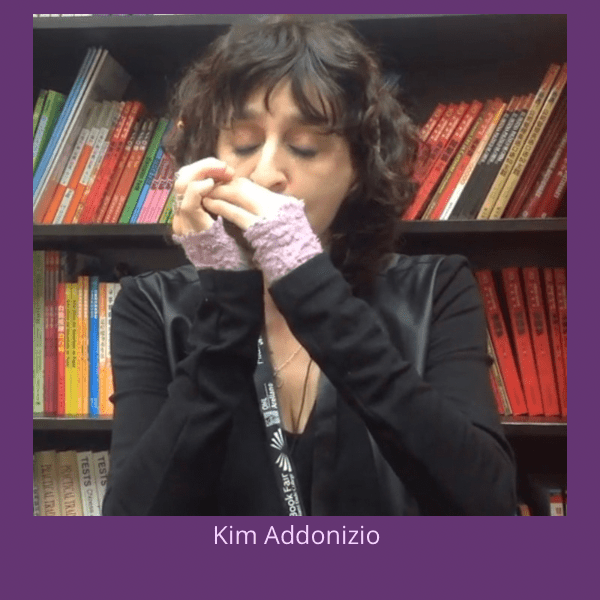
Nació en Washington DC. Es Poeta, Novelista, Músico y Docente. Estudió en la Universidad de San Francisco. Mezcla la poesía con la música.
Fue Finalista del Premio Nacional del Libro, en el año 2000.
Kim Addonizio ha publicado: Qué quieren las mujeres, Comer juntos, 2003. La primera línea es la más profunda, 2009. Mi ángel negro; Blues, poemas y retratos. Mortal trash, 2016.
Kim Addonizio también ha escrito una importante colección dedicada a la reflexión sobre la creación poética, sobre el arte de escribir versos.
Kim Addonizio vive Actualmente en San Francisco.
INTIMIDAD


La mujer en el café que prepara mi capuchino –ojos negros, cabello rojo teñido

cuello de tortuga negro y sin mangas –solía ser amante del hombre con quien salgo ahora.

Ella no me conoce; somos extrañas, y aun así no puedo mirarla

casualmente, como solía, antes de saberlo. Ella está parada frente a la máquina, hundiendo la válvula

en la espuma de la leche, mirando al vacío –no sé qué es lo que piensa.

Por lo que yo sé, ella podría estar recordando a mi amante, recordando cualquier cosa que haya ocurrido

entre ellos–él nunca me contó nada, excepto que no había sido importante, y luego

cambió el tema rápidamente, demasiado rápido ahora que lo pienso, ¿podría ser que él,

después de todo, hubiera mentido? ¿y no pasó por su rostro, tan sólo un instante,

una expresión de dolor? No puedo estar segura. ¿Y si realmente no fue nada? me digo a mí misma,

no hay razón para sentirme extraña ahí parada o cómplice,

como si hubiera algo importante entre nosotras.

Ella podría estar pensando en cualquier cosa; entonces, ¿por qué tengo la súbita sospecha

de que ella sabe, de que me siente estudiándola, tratando de imaginarlos juntos?–

Su labial de un rojo oscuro, más oscuro que su cabello–tratando de verlo besándola, girándola en la cama

de la manera en que le gusta tenerme. Me pregunto si tal vez

había cosas en ella que él prefería, cosas que él extraña ahora que estamos juntos;

a veces, cuando él y yo estamos haciendo el amor, hay momentos

en los que me abruma la tristeza, y aun cuando estoy con él no puedo evitar pensar

en las manos de mi ex esposo, que me gustaban de manera especial, y quisiera volver

a esa vieja intimidad, que solía sentirse como la más pura felicidad

que hubiera conocido o pudiera conocer. Pero todo eso se ha terminado; y además, ¿no hubieron otros amantes

que no dejaron rastro? Cuando los veo ahora, apenas puedo recordar

cómo se veían desnudos, o cómo se sentía tenerlos

dentro de mí. Entonces, ¿qué es lo que siento mientras ella vierte el obscuro espresso en la leche,

y empuja la taza hacia mí, y yo le doy el dinero,

y nuestros ojos se encuentran por sólo un segundo, y nuestros dedos se tocan?


INTIMACY


The woman in the cafe making my cappuccino — dark eyes, dyed red hair,

sleeveless black turtleneck — used to be lovers with the man I’m seeing now.

She doesn’t know me; we’re strangers, but still I can’t glance at her

casually, as I used to, before I knew. She stands at the machine, sinking the nozzle

into a froth of milk, staring at nothing — I don’t know what she’s thinking.

For all I know she might be remembering my lover, remembering whatever happened

between them — he’s never told me, except to say that it wasn’t important, and then

he changed the subject quickly, too quickly now that I think about it; might he,

after all, have been lying, didn’t an expression of pain cross his face for just

and instant? I can’t be sure. And really it was nothing, I tell myself;

there’s no reason for me to feel awkward standing here, or complicitous,

as though there’s something significant between us.

She could be thinking of anything; why, now, do I have the sudden suspicion

that she knows, that she feels me studying her, trying to imagine them together?—

her lipstick’s dark red, darker than her hair — trying to see him kissing her, turning her over in bed

the way he likes to have me. I wonder if maybe

there were things about her he preferred, things he misses now that we’re together;

sometimes, when he and I are making love, there are moments

I’m overwhelmed by sadness, and though I’m there with him I can’t help thinking

of my ex-husband’s hands, which I especially loved, and I want to go back

to that old intimacy, which often felt like the purest happiness

I’d ever known, or would. But all that’s over; and besides, weren’t there other lovers

who left no trace? When I see them now, I can barely remember

what they looked like undressed, or how it felt to have them

inside me. So what is it I feel as she pours the black espresso into the milk,

and pushes the cup toward me, and I give her the money,

and our eyes meet for just a second, and our fingers touch?


**********


“¿QUÉ QUIEREN LAS MUJERES?”


Quiero un vestido rojo.

Lo quiero ligero y barato.

Lo quiero muy ajustado, y quiero usarlo

hasta que alguien me lo arranque.

Lo quiero sin mangas y con la espalda descubierta,

este vestido, para que nadie tenga que adivinar

lo que hay debajo. Quiero recorrer

la calle y pasar por “Thrifty’s” y la cerrajería

con todas esas llaves brillando en la ventana,

pasar frente al señor y la señora Wong que venden donuts

del día anterior en su café, pasar a los hermanos Guerra

arrojando cerdos desde su camión hasta el contenedor,

cargando los escurridizos hocicos sobre sus hombros.

Quiero caminar como si fuera la última

mujer sobre la tierra y pudiera elegir a quien yo desee.

Me muero por ese vestido rojo.

Quiero que confirme

tus peores miedos sobre mí,

que te muestre qué poco me importas tú,

o cualquier cosa que no sea

lo que yo quiero. Cuando lo encuentre, jalaré esa prenda

del gancho como si estuviera escogiendo un cuerpo

para transportarme en este mundo, a través

de los llantos de nacimiento y los llantos por amor,

y lo vestiré como huesos, como piel,

y será el maldito

vestido con el que me entierren.


“WHAT DO WOMEN WANT?”


I want a red dress.

I want it flimsy and cheap,

I want it too tight, I want to wear it

until someone tears it off me.

I want it sleeveless and backless,

this dress, so no one has to guess

what’s underneath. I want to walk down

the street past Thrifty’s and the hardware store

with all those keys glittering in the window,

past Mr. and Mrs. Wong selling day-old

donuts in their café, past the Guerra brothers

slinging pigs from the truck and onto the dolly,

hoisting the slick snouts over their shoulders.

I want to walk like I’m the only

woman on earth and I can have my pick.

I want that red dress bad.

I want it to confirm

your worst fears about me,

to show you how little I care about you

or anything except what

I want. When I find it, I’ll pull that garment

from its hanger like I’m choosing a body

to carry me into this world, through

the birth-cries and the love-cries too,

and I’ll wear it like bones, like skin,

it’ll be the goddamned

dress they bury me in.


VASO


En todos los bares una persona se sienta sola y se abstrae completamente

por lo que sea que encuentra en el vaso frente a ella,

un vaso que parece ordinario, con algo claro u oscuro

en su interior, algo parcialmente ebrio pero nunca completamente extraviado.

Todo está ahí: los planes que fracasaron,

los amores estúpidos y los terribles, aquellos donde la felicidad actual

se abrió como un agujero debajo de sus pies y esta persona cayó, y permaneció ahí indefensa,

mientras la tierra caía poco a poco para enterrarla.

Y sus amigos están ahí, abriendo una cerveza tras otra, levantando las botellas,

el sonido de su reunión como el de un taco de billar

golpeando una bola, la bola incorrecta, que ahora se dirige, negra y brillante,

hasta el cesto que la espera. Pero se queda corta, y la solitaria persona que bebe en el bar

se decide por golpear la siguiente. Ahora los miembros de la familia flotan por el aire

con sus fracasos, con cáncer, con vajillas de culpa que deben lavar,

con un poco de risa también, incluso de belleza –alguna tarde de la infancia,

un lago, un juego de pelota, un libro de cuentos, algunos copos de nieve

que se hacen gruesos y gradualmente cubren la tierra hasta que el mundo

entero se vuelve blanco y callado, hasta que difícilmente puede decirse que sigue

existiendo un mundo, no hay tráfico, no hay dinero ni carnicerías ni sexo,

sólo una bendita paz que parece ser el fin pero no lo es. Y finalmente,

el vaso que contiene y derrama estas cosas de modo continuo,

mientras quien bebe se inclina hacia él, mientras el cantinero junta

los vasos sucios, refleja la cara del bebedor. ¿Qué importa cómo se ve?;

¿a quién le importa si fue o no joven alguna vez, o alguna vez encantador?

¿a quién le importa un carajo un borracho que se levanta tambaleándose

hacia el baño, sea un hombre o mujer, o incluso un ángel perdido

que lo tiró todo –el paraíso, el éter,

los trabajos celestiales- y dijo, A la mierda, quiero ser humano?

¿Quién cree en los ángeles, de todos modos? ¿Quién tiene tiempo sino para

sus propios placeres y penas, para la poca buena gente

que han logrado reunir alrededor de ellos frente a la incertidumbre,

frente a tardes en las que se sientan solas en un bar

con un nombre como Embers o Ninth Inning o Wishing Well?

Olvida a ese perdedor. Sólo dime quién invita, quién paga:

¡Dios! pero qué sedienta estoy y quiero decirte una cosa,

acércate, quiero susurrártela, verter

las palabras ardiendo dentro de ti, las mismas palabras para cada uno de ustedes,

escucha, es simple, lo estoy diciendo ahora, mientras sigo sobria,

antes de estar a punto de llorar amargamente en mi propio vaso,

mientras estás aún aquí –no te vayas, quédate, quédate,

dame tu hombro para que me recargue, tranquilízame, no me dejes caer,

estoy tan enamorada de ti que no me puedo levantar.


GLASS


In every bar there’s someone sitting alone and absolutely absorbed

by whatever he’s seeing in the glass in front of him,

a glass that looks ordinary, with something clear or dark

inside it, something partially drunk but never completely gone.

Everything’s there: all the plans that came to nothing,

the stupid love affairs, and the terrifying ones, the ones where actual happiness

opened like a hole beneath his feet and he fell in, then lay helpless

while the dirt rained down a little at a time to bury him.

And his friends are there, cracking open six-packs, raising the bottles,

the click of their meeting like the sound of a pool cue

nicking a ball, the wrong ball, that now edges, black and shining,

toward the waiting pocket. But it stops short, and at the bar the lone drinker

signals for another. Now the relatives are floating up

with their failures, with cancer, with plateloads of guilt

and a little laughter, too, and even beauty—some afternoon from childhood,

a lake, a ball game, a book of stories, a few flurries of snow

that thicken and gradually cover the earth until the whole

world’s gone white and quiet, until there’s hardly a world

at all, no traffic, no money or butchery or sex,

just a blessed peace that seems final but isn’t. And finally

the glass that contains and spills this stuff continually

while the drinker hunches before it, while the bartender gathers

up empties, gives back the drinker’s own face. Who knows what it looks like;

who cares whether or not it was young once, or ever lovely,

who gives a shit about some drunk rising to stagger toward

the bathroom, some man or woman or even lost

angel who recklessly threw it all over—heaven, the ether,

the celestial works—and said, Fuck it, I want to be human?

Who believes in angels, anyway? Who has time for anything

but their own pleasures and sorrows, for the few good people

they’ve managed to gather around them against the uncertainty,

against afternoons of sitting alone in some bar

with a name like the Embers or the Ninth Inning or the Wishing Well?

Forget that loser. Just tell me who’s buying, who’s paying;

Christ but I’m thirsty, and I want to tell you something,

come close I want to whisper it, to pour

the words burning into you, the same words for each one of you,

listen, it’s simple, I’m saying it now, while I’m still sober,

while I’m not about to weep bitterly into my own glass,

while you’re still here—don’t go yet, stay, stay,

give me your shoulder to lean against, steady me, don’t let me drop,

I’m so in love with you I can’t stand up.


 ******


POEMA COLAPSÁNDOSE


La mujer se encuentra en los escalones de la entrada, llorando.

El hombre permanece dentro de la casa,

apoyado contra la puerta. Es tarde, la húmeda

neblina ha dejado una capa de vapor sobre las ventanas

de los coches a lo largo de la calle. La mujer está borracha.

Le ruega al hombre pero él no la deja entrar.

Di que lo que importa es qué haya pasado entre ellos;

di que no puedes juzgar de quién es la culpa,

debido a la falta de contexto, debido a tus propias derrotas

con aquellos a los que más deseabas amar.

O tal vez, ellos aún no te interesan.

Tal vez necesitas de algún modo

meterte en la escena, algún pequeño detalle

que los haga parecer tan reales que trates de adentrarte

en esta página para evitar que se hagan uno al otro

aquello que tú le has hecho a alguien,

en algún lugar: piénsalo por un minuto,

mientras ella sigue llorando y él habla

en una voz tan medida y calmada que parecería

que está hablándole a un niño asustado por algo

totalmente común: la oscuridad, los truenos,

la frialdad del corazón humano.

Pero ella no escucha, porque ahora

ella le está pegando, golpea con sus nudillos el pecho

sobre el que se ha recostado tantas noches.

Y a estas alturas, si la historia te ha conmovido, es porque

estás pensando con arrepentimiento en la persona

que este poema hizo que recordaras,

y lo que quieres más que cualquier cosa es

lo que el hombre en el poema desea: que ella simplemente se calle.

Y si tan sólo pudieras manejar por ese camino

y emerger de la niebla, tal vez tú

podrías lograr que ella se detenga pero yo no puedo hacerlo.

Todo lo que puedo hacer es mantenerme al lado de la puerta abierta

empeorando las cosas. Ese es mi talento,

esa es la razón por la cual este poema no va a terminar a menos

que me arrastres de él, lejos de ese hombre;

por amor de Dios, date prisa, sólo estaciónate, deja

el motor encendido y llévame a donde quiera que vayas.


COLLAPSING POEM


The woman stands on the front steps, sobbing.

The man stays just inside the house,

leaning against the doorjamb. It's late, a wet

fog has left a sheer film over the windows

of cars along the street. The woman is drunk.

She begs the man, but he won't let her in.

Say it matters what happened between them;

say you can't judge whose fault this all is,

given the lack of context, given your own failures

with those you meant most to love.

Or maybe you don't care about them yet.

Maybe you need some way

to put yourself in the scene, some minor detail

that will make them seem so real you try to enter

this page to keep them from doing

to each other what you've done to someone,

somewhere: think about that for a minute,

while she keeps crying, and he speaks

in a voice so measured and calm he might be

talking to a child frightened by something

perfectly usual: darkness, thunder,

the coldness of the human heart.

But she's not listening, because now

she's hitting him, beating her fists against the chest

she laid her head on so many nights.

And by now, if you've been moved, it's because

you're thinking with regret of the person

this poem set out to remind you of,

and what you want more than anything is what

the man in the poem wants: for her to shut up.

And if you could only drive down that street

and emerge from the fog, maybe you

could get her to stop, but I can't do it.

All I can do is stand at that open door

making things worse. That's my talent,

that's why this poem won't get finished unless

you drag me from it, away from that man;

for Christ's sake, hurry up, just pull up and keep

the motor running and take me wherever you're going.


*******


PRIMER POEMA A TI


Me gusta tocar tus tatuajes en total

oscuridad, cuando no puedo verlos. Sé con precisión

dónde están, conozco de memoria las delicadas

líneas de pulsante luminosidad sobre

tu pezón, puedo encontrar, como por instinto, los azules

remolinos de agua en tu hombro donde una serpiente

se enrolla, enfrentando a un dragón. Cuando te jalo


hacia mí, tomándote hasta que estamos apagados

y quietos en las sábanas, adoro besar

los dibujos en tu piel. Ellos durarán hasta

que seas ceniza; cualquier cosa que permanezca

o se transforme en dolor entre nosotros, ellos seguirán

ahí.  Esta permanencia es aterradora.

Así que los toco en la oscuridad; pero los toco, tratando.


FIRST POEM FOR YOU


I like to touch your tattoos in complete

darkness, when I can’t see them. I’m sure of

where they are, know by heart the neat

lines of lightning pulsing just above

your nipple, can find, as if by instinct, the blue

swirls of water on your shoulder where a serpent

twists, facing a dragon. When I pull you

.

to me, taking you until we’re spent

and quiet on the sheets, I love to kiss

the pictures in your skin. They’ll last until

you’re seared to ashes; whatever persists

or turns to pain between us, they will still

be there. Such permanence is terrifying.

So I touch them in the dark; but touch them, trying.


Traducción: Andrea Muriel
Kim Addonizio en La maja desnuda, UPV Radio, conduce: Nidia Hernández